


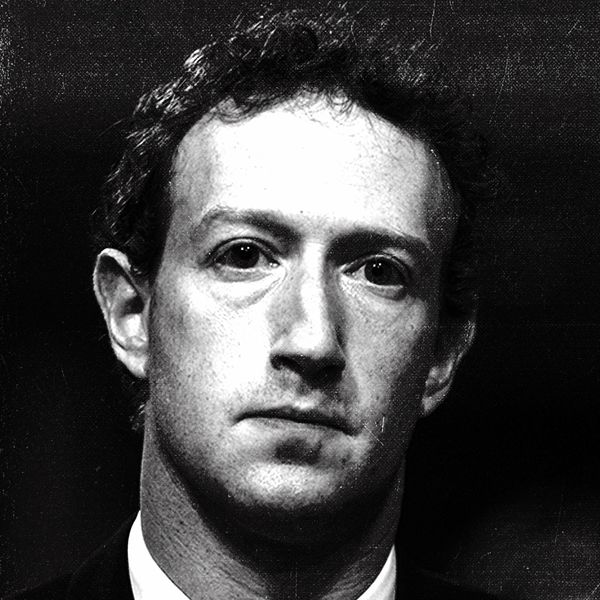
Mark Zuckerberg
KEY THREATS:
 Military-industrial complex Surveillance state Deportation industrial complex AI Data Center Explosion
Like many tech oligarchs, Facebook founder Mark Zuckerberg went from nominal Trump critic to the president’s Close Friends Circle. Which makes sense for someone facing a decade of scandals over privacy breaches, misinformation, mental health impacts on content moderators and children, role in a genocide, and potentially poisoning a community’s water supply.
After rolling purchases of Instagram and WhatsApp into new umbrella company Meta, Zuckerberg has gone all in on AI, planning to spend $130 billion on data center projects despite overall profits falling 14%. Fortunately for him, a private dinner and $1 million donation to Trump’s inauguration fund was followed by an appointment to the 13-person President’s Council of Advisors on Science and Technology (PCAST), which advises the president on matters like AI. This is a surprising turn of events given that in 2020, Facebook banned Trump for incitement on January 6th and Trump responded in 2024 with a threat to send Zuckerberg to prison for life.
In 2025, Zuckerberg received media attention for wearing a gold chain and saying things like, "a lot of the corporate world is pretty culturally neutered," and would benefit from having more "masculine energy." So far, that seems to mean selling a product now increasingly known as “pervert glasses.”
NET WORTH
Founder, CEO and Chairman
Meta Platforms
OTHER COMPANIES
Chan Zuckerberg Initiative (Co-Founder and Co-CEO), President’s Council of Advisors on Science and Technology (PCAST)
LINKED TO
Peter Thiel, Donald Trump, Marc Andreessen, Jared Kushner, Jeffrey Epstein
AGE
42
STATE
California

PART OF
Linked To
Peter Thiel
The far right funder and Palantir co-founder is a mentor to Zuckerberg, and was the first major investor in Facebook, serving on its board for nearly two decades.
Donald Trump
A former foe and now a friend of Zuckerberg, sharing meals at the White House and Mar-A-Lago ever since 2024. Trump has previously threatened to jail Zuckerberg for what he perceived as censorship when Facebook (Meta) banned Trump’s account after January 6th, but became a close ally after the election in 2024 after Zuckerberg began supporting and donated to the inaugural fund.
Marc Andreessen
Former board member of Meta and an early mentor to Zuckerberg. Text messages between the two men surfaced during a 2016 lawsuit against Facebook for plans to re-structure Facebook’s stock. Then independent board member Andreessen coached Zuckerberg on how to present his case to the board.
Jared Kushner
Was a regular interlocutor to Zuckerberg during the first Trump administration.
Jeffrey Epstein
The latest release of the Epstein files has 280 references to Zuckerberg, including an email sent from Epstein’s assistant to Zuckerberg in 2015 referencing Epstein and Zuckerberg meeting at a dinner, and providing Epstein's contact information to Zuckerberg.
Controversies
- Watchdog groups including Amnesty International accused Facebook of amplifying hate in the years leading up to the genocide of the Rohingya minority in Myanmar. In 2021, whistleblower Frances Haugan, a former Facebook product manager, testified to Congress that Facebook was “literally fanning ethnic violence” in Ethiopia by failing to police Facebook’s use in Ethiopia, which Zuckerberg denied. According to a Reuters special report, Facebook failed to promptly heed numerous warnings from organizations in Myanmar about social media posts fueling attacks on the Rohingya. In 2018, Facebook admitted: “we have been too slow to prevent misinformation on Facebook.”
- Meta was fined $567 million in August 2026 by a judge in New Mexico in a child safety ruling that compares Meta’s impacts on child psychology as akin to environmental pollution. This is in addition to $375 million in penalties Meta was already ordered to pay for misleading users about child safety issues, for a total of $942 million. According to news reports as of October 2026, Meta has stated an intention to appeal both rulings.
- In October 2026, a New Mexico judge ordered Meta to pay $25 billion for misleading users about data privacy. According to news reports as of October 2026, the company plans to appeal the decision.
- In August 2026, Meta settled similar cases from a coalition of 29 state attorneys general over products causing severe mental health and child brain development impacts on young people. The case argues that Meta’s platforms keep children hooked on their platforms and has misled users about the safety of these products. Additionally, all 29 states argue that the company illegally collects and uses children's data, and in so doing violates federal law.
- In 2018, the Steve Bannon-linked Cambridge Analytica scandal revealed that 50 million Facebook users’ data was harvested and used to aid campaigns in support of Donald Trump’s 2016 Presidential election.
- In 2016, Meta began “Project Atlas,” where it paid teens and others up to age 35 $20 a month to install a “research app” that vacuumed up their private messages, web searches, and location data—disguised as a third-party beta test. It was not uncovered until three years later.
- Personally greenlit “Project Ghostbusters,” a “man-in-the-middle” attack on apps like Snapchat and YouTube to get a peek at their analytics as competition. According to TechCrunch, Facebook’s then-head of security engineering expressed concern over the project, saying, “I can’t think of a good argument for why this is okay. No security person is ever comfortable with this, no matter what consent we get from the general public. The general public just doesn’t know how this stuff works.”
- Has personally hosted private events with far right public figures like Ben Shapiro and Tucker Carlson, who have large followings on Meta’s social media platforms.
- Meta announced in early 2026 plans to spend $65 million supporting state politicians who are friendly to the AI industry.
Obscene Spending
- Built an estate in Kauai, Hawaii, estimated to cost $300 million, part of which is built on top of a burial ground. Zuckerberg is one of the largest landowners in Hawaii.
- Spent $27 million in 2024 alone on private security detail.
- Owns a $300 million superyacht.
Enabling
AI Data Centers
With backing from Donald Trump, Meta has put AI and data center infrastructure at the center of its business. Data centers are wildly unpopular, with 7 in 10 Americans saying in March they opposed data center construction where they live, citing their role in skyrocketing utility bills, massive consumption of water, and reliance on fossil fuels. Meta expects to spend at least $130 billion on data center buildout in 2026.
Already built data centers have been linked to potential health issues across the country. In Newton County, Georgia, Meta began construction on a massive data center in 2018 that has created severe water access issues for residents as well as unprecedented water rate hikes for local residents, who claim they have become afraid to drink their own well water. In planning the building of the data center, the company also bulldozed an oak tree forest in the area. Residents are reporting low water pressure and brown water coming from their taps, and needing to replace their water filters monthly instead of yearly as was previously the case. After wastewater from the construction and commissioning of a Meta data center in Cheyenne, Wyoming entered the city’s wastewater network, a rare bacteria called Cupriavidus gilardii was detected in the city’s reclaimed water supply. While city officials reported that the bacteria was not found in the drinking supply, there was concern that residents could experience the effects of this contamination via inhaling aerosolized droplets when reclaimed waste water is used for processes such as irrigation.
Aiding and Abetting Immigration and Customs Enforcement
At the height of resistance to ICE’s occupation of Minneapolis, MN in January 2026, Meta prevented users on Facebook, Instagram, and Threads from sharing a database containing the names and photos of US ICE Enforcement agents. Meta began blocking the database, which the creator described as an attempt to track ICE agents and vehicles to hold them accountable for abuses of power, from its platforms. The database included a page that was created where people could submit tips about the ICE agents involved in Alex Pretti’s fatal shooting.
The database was being shared as thousands of people were being unlawfully arrested and there were two fatal shootings of residents by ICE agents. While Meta claimed that the database violated its privacy policy, critics point out that the sites are inconsistent in their enforcement of this policy given that users of these sites regularly share other types of websites that contain personal information.