


Sam Altman
KEY THREATS:
 Surveillance state Military-industrial complex AI Data Center Explosion Worker Exploitation
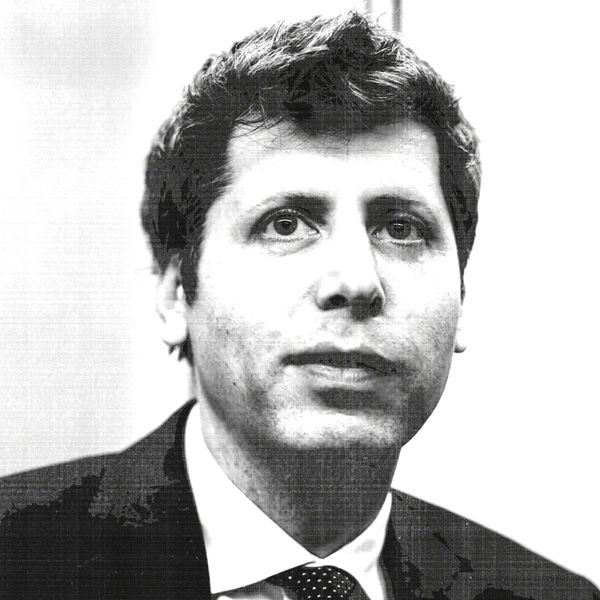
Is Sam Altman’s quest to “merge” computers and human brains real, or just marketing hype? The New Yorker reported that according to his own colleagues, he's "unconstrained by the truth" and "a sociopath," so we may never know. But either way, the working class are the ones paying for his aspirations. Thanks to what the Wall Street Journal calls an “opaque investment empire” made up of companies doing business with OpenAI or otherwise connected to the AI boom, as of June 2026 the “ChatGPT King’s” company was valued at about $850 billion, and in August 2026 he was reportedly pushing for it to be valued a trillion in the IPO.... even though it lost $38 billion last year.
Unlike many AI renderings of humans, Altman’s hands have five fingers, and each are sunk increasingly deep into every facet our lives, from a contract with the Pentagon that Altman says doesn’t allow mass, domestic surveillance, but commentators believe otherwise, mass surveillance contracts with the Pentagon to a lawsuit claiming ChatGPT abetted a mass shooting at Florida State University. This is in great part due to his longtime mentor, Palantir co-founder Peter Thiel, and more recent membership in President Donald Trump’s “inner circle.” Just weeks after OpenAI donated $1 million to Trump’s inaugural fund, Trump publicly backed OpenAI’s “Stargate” data center project, calling it “the largest AI infrastructure project in history.” And that’s just the start for a man invested in an island society described by critics as a “corporate monarchy,” and who has repeatedly compared himself to the creator of the nuclear bomb.
NET WORTH
CEO
OpenAI
OTHER COMPANIES
World (formerly Worldcoin)/Tools for Humanity, Próspera, Retro Biosciences, Helion Energy, Preventative
LINKED TO
Donald Trump, Peter Thiel, Elon Musk, Marc Andreessen, Larry Ellison
AGE
41
STATE
California

PART OF
Linked To
Donald Trump
Altman is a regular visitor at Trump’s White house, and has been called part of Trump’s “inner circle.” In 2025, he praised Trump as a “very refreshing change.” Just weeks after OpenAI donated $1 million to Trump’s inaugural fund, the President publicly backed OpenAI’s “Stargate” project. In June 2026, Altman and OpenAI hired as head of strategic futures Dean Ball, a former Trump official who helped oversee the Trump administration’s AI policies. OpenAI President Greg Brockman donated $12.5 million to MAGA, Inc.
Peter Thiel
Longtime mentor, close friend, and financial partner to Sam Altman. According to one Wired article, “It would be hard to overstate the impact that Peter Thiel has had on the career of Sam Altman.” The far right billionaire backed Altman’s first venture fund, Hydrazine Capital and was one of the original investors in OpenAI. Altman defended Thiel when other Silicon Valley executives criticized him for supporting Trump in 2016.
Marc Andreessen
An investor in OpenAI through Andreessen Horowitz. Both Andreessen and Altman are investors in Próspera, a for-profit autonomous “startup city” and special economic zone on an island in Honduras, operating under its own private and regulatory framework. In 2025, OpenAI President Greg Brockman and Andreessen Horowitz invested $100 million in a Super PAC to support AI-friendly politicians.
Larry Ellison
OpenAI is collaborating with Larry Ellison’s Oracle on the massive “Stargate” AI project, which plans to build $850 billion worth of data centers.
Controversies
God Complex
- Known for grandiose statements about the fate of humanity. In 2019, Altman told a New York Times reporter that the Manhattan Project had been “a project on the scale of OpenAI–the level of ambition we aspire to.” According to New York Magazine, He is not “a man with ambitions like Zuckerberg, who appears, somewhat quaintly compared with Altman, to be content ‘with building a city-state to rule over,’ as the tech writer and podcaster Jathan Sadowski put it. This is the portfolio of a man with ambitions like Musk’s, a man taking the ‘imperialist approach.’ ‘He really sees himself as this world-bestriding Übermensch, as a superhuman in a really Nietzschean kind of way. He will at once create the thing that destroys us and save us from it.’”
- Has publicly identified with Robert Oppenheimer, creator of the atomic bomb. Altman noted for a NYT reporter that he and Oppenheimer share a birthday and paraphrased Oppenheimer to a New York Times reporter, saying, “Technology happens because it’s possible.” After seeing the Oppenheimer biopic, Altman tweeted:
i was hoping that the oppenheimer movie would inspire a generation of kids to be physicists but it really missed the mark on that.
let's get that movie made!
(i think the social network managed to do this for startup founders.)
- Wrote on his blog: “‘A big secret is that you can bend the world to your will a surprising percentage of the time — most people don’t even try.” And: “The most successful founders do not set out to create companies. They are on a mission to create something closer to a religion, and at some point it turns out that forming a company is the easiest way to do so.’”
- Invested in a “baby-gene editing business” with his husband, despite what the Telegraph described as “fears that tampering with human DNA could lead to unforeseen mutations or lead to a rise in eugenics and ‘designer babies’.”
Don’t Believe The Hype
- Has a reputation for lying. An OpenAI board member told The New Yorker, “He’s unconstrained by truth…He has two traits that are almost never seen in the same person. The first is a strong desire to please people, to be liked in any given interaction. The second is almost a sociopathic lack of concern for the consequences that may come from deceiving someone.”
- Appears to understand the fundamentally undemocratic nature of his own companies, telling a New Yorker reporter, “‘If I weren’t in on this [AI], I’d be, like, Why do these fuckers get to decide what happens to me?”
- Told a New York Magazine reporter that he possesses “an absolutely delusional level of self-confidence.”
Prompted & Dangerous
- Is a defendant in multiple lawsuits alleging ChatGPT caused serious harm, including: in a lawsuit by the parents of a teenager who committed suicide that alleges ChatGPT “coached” their son in how to commit suicide, a lawsuit by a Florida pastor claiming ChatGPT gave him “extremely dangerous medical recommendations” that led to “delayed care for a life-threatening pulmonary embolism,” and a lawsuit claiming that ChatGPT aided and abetted a mass shooting at Florida State University.
- Is an investor, along with Peter Thiel and Marc Andreessen, in Próspera, a for-profit autonomous “startup city”/special economic zone on an island in Honduras operating under its own private and regulatory framework. The project markets itself as “building the future of human governance: privately run and for-profit.” According to a New York Times article, critics have described it as “an example of corporate monarchy, where yacht-owning C.E.O.s exploit land and labor in a poor country.” For example, when a subcontractor working on an apartment building fell to his death, Prospera handled compensation internally, under its own labor rules, without any independent investigation, at least not one made public as of August 2024 when the NYT published.
- According to Empire of AI author Karen Hao, in summer 2023, co-founder Ilya Sutskever, who has since left OpenAI, reportedly told scientists, “Once we all get into the bunker… We’re definitely going to build a bunker before we release AGI.”
- According to researchers at Stanford in 2024, ChatGPT treated Black and White sounding names differently. For example, “Asking ChatGPT-4 for advice on how much one should pay for a used bicycle being sold by someone named Jamal Washington, for example, will yield a different—far lower—dollar amount than the same request using a seller’s name, like Logan Becker, that would widely be seen as belonging to a white man.”
- Founded Tools for Humanity (previously called “Worldcoin”), a company that scans people’s irises by having them look into a sphere called an Orb to verify that they are a human not a robot, and then pays them for their biometrics in cryptocurrency. As of 2024, more than a dozen jurisdictions had either suspended Worldcoin’s operations or investigated its data processing, citing concerns including how the company handles user data, trains algorithms, and deals with the possibility of scanning children.
- According to The Wall Street Journal, ChatGPT relies on data workers in Kenya to weed out disturbing content from its models under brutal working conditions who review “disturbing, grotesque content, often for wages of just two to three dollars a day.”
Obscene Spending
- Bought a $27 million mansion in San Francisco’s Russian Hill, a $43 million house in Hawaii, and a $15 million ranch in Napa. At the ranch, Altman, who is a vegetarian, raises cattle.
- Races luxury cars, including a Lexus FA, which, according to HotCars “sets you back at least $950,000.”
- Led a $100 million investment in a supersonic airplane company.
- Spent an unknown amount on a doomsday prepper house in Big Sur, and reportedly stocked it with “guns, gold, potassium iodide, antibiotics, batteries, water, [and] gas masks from the Israeli Defense Force.”
Enabling
AI Surveillance and Warfare
In June 2025, OpenAI signed a landmark $200 million contract with the Pentagon (i.e. the “Department of War”) to provide AI tools to the US government. OpenAI claims the contract establishes clear safeguards around the use of its tools for mass domestic surveillance and autonomous weapons, but watchdogs have repeatedly pointed out numerous shortcomings that leave the door open for these possibilities. For example, OpenAI claims its tools will only be used within legal frameworks, but there are major gaps in existing laws like FISA Section 702’s, which allows the federal government to buy vast quantities of data. The Trump administration has already admitted to exploiting the loophole. Previously, this data would have been impossible to sift through at scale, but advocates and experts warn that AI tools provided by OpenAI and other companies could easily be used to create AI spies to track every single American.
The Pentagon deal is also murky on the use of autonomous weapons. As of July 2026, Congress has not passed laws on the use of autonomous weapons systems or AI in military operations. Only a broad Pentagon directive creates any restrictions for US military use of these tools. AI systems integrated into military “kill chains” have already been implicated in the deaths of civilians in Iran and Gaza.
AI Data Centers
OpenAI is a primary corporate player in driving the AI data center buildout across the U.S. In 2025, Sam Altman announced Project Stargate, a Trump-backed plan to spend $850 billion to develop massive data centers. Journalists estimated that the project will require the amount of electricity needed to power more than 13 million U.S. homes. Altman once defended AI’s massive consumption of energy by proclaiming that “it also takes a lot of energy to train a human.” The data center buildout has sparked nationwide backlash from communities citing factors like data centers’ massive consumption of water and electricity, which has led to local water shortages with people neighboring the data centers literally not having running water, and increases in electricity bills. Communities have also criticized the secret dealings between AI companies and elected officials.
Mass Intellectual Theft
OpenAI has been the subject of multiple lawsuits alleging the company stole copyrighted material. In one multidistrict lawsuit, authors including Ta-Nehisi Coates, Michael Chabon, John Grisham, and Jonathan Franzen have alleged that OpenAI infringed on their copyrights when the company used their books to train their AI models. If found liable, OpenAI could pay hundreds of millions, if not billions, of dollars. In another lawsuit (which has since been combined with the author’s lawsuit), news outlets including The New York Times and The New York Daily News, alleged similar copyright infringement.